

One of the most consistent findings in digital products is also one of the most discouraging: most users don’t stay. Often, apps are downloaded with interest, yet within just a few weeks they fall into disuse. As an expert in user behavior research, I have seen this pattern many times when analyzing usability data, which brings me to the next questions:
Why does this happen? What sets apart the few apps that people use regularly from the many that are quickly abandoned?
This post examines insights from cognitive science regarding user engagement. It delves into how engagement evolves over time, considering the underlying brain processes as a key factor that explains why certain apps achieve lasting user engagement while many others do not.
Time and Engagement: A Fragile Curve
Long-term engagement is the measure of success for any digital experience.
But the reality is different: user activity almost always declines, following a predictable curve that repeats itself across sectors.

For instance, in digital mental health apps, the median 30-day retention is just 3.3% (Boucher & Raiker, 2024). Longitudinal studies also reveal a significant decline pattern in user engagement over time. Critically, after 78 weeks, approximately 70% of users become inactive, 18% exhibit moderate usage, and merely 12% remain highly engaged (Agachi et al., 2021; Boucher & Raiker, 2024).
Fitness apps perform no better. According to recent industry benchmarks, retention after 30 days rarely exceeds 3–4% (UXCam, 2024), showing that even highly goal-oriented products struggle to keep users active beyond the first month.
In gaming, often considered the benchmark for sticky design, industry reports still show that fewer than 10% of players return after 30 days (GameAnalytics, 2023; Adjust, 2023).
And in productivity or learning apps, the pattern is much the same, with most platforms showing steep early drop-offs with average 30-day retention typically below 10% (Business of Apps, 2024). In this sector, Duolingo is the striking exception, reporting monthly retention of around 55%. The number looks remarkable precisely because it breaks the curve. But why does Duolingo stand out as an outlier? What does it get right that most others miss?
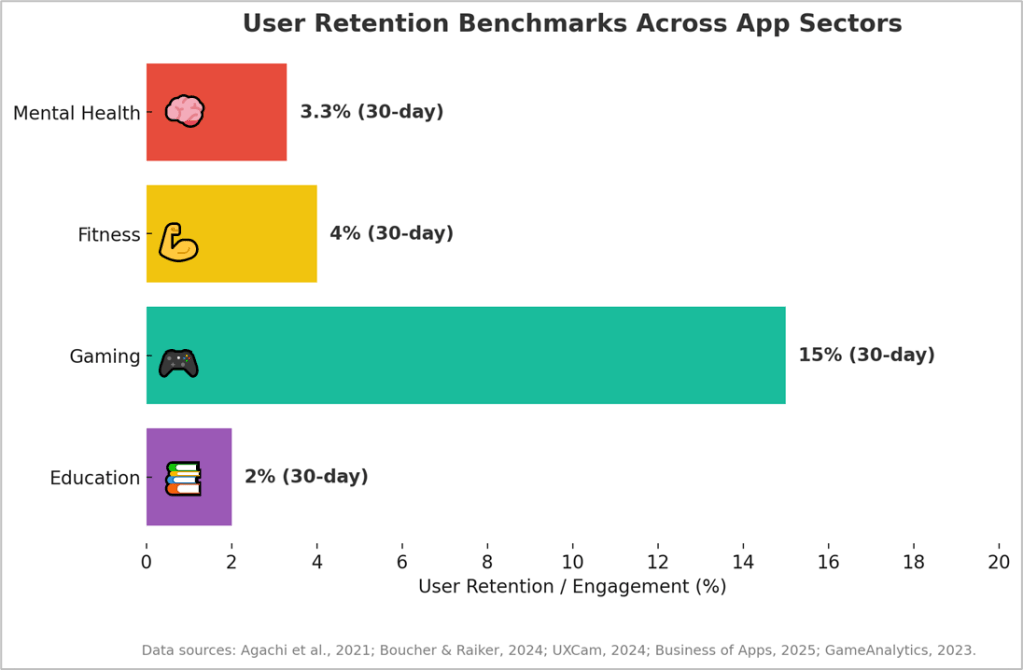
This cross-sector evidence underlines a fragile truth: curiosity brings people in, but without sustained value, most drift away. From a cognitive neuroscience perspective, this makes sense. The brain abandons habits as quickly as it forms them. Unless early interactions deliver timely rewards, minimize cognitive effort, and generate emotional salience, disengagement is the rule.
The Brain Basis of Engagement
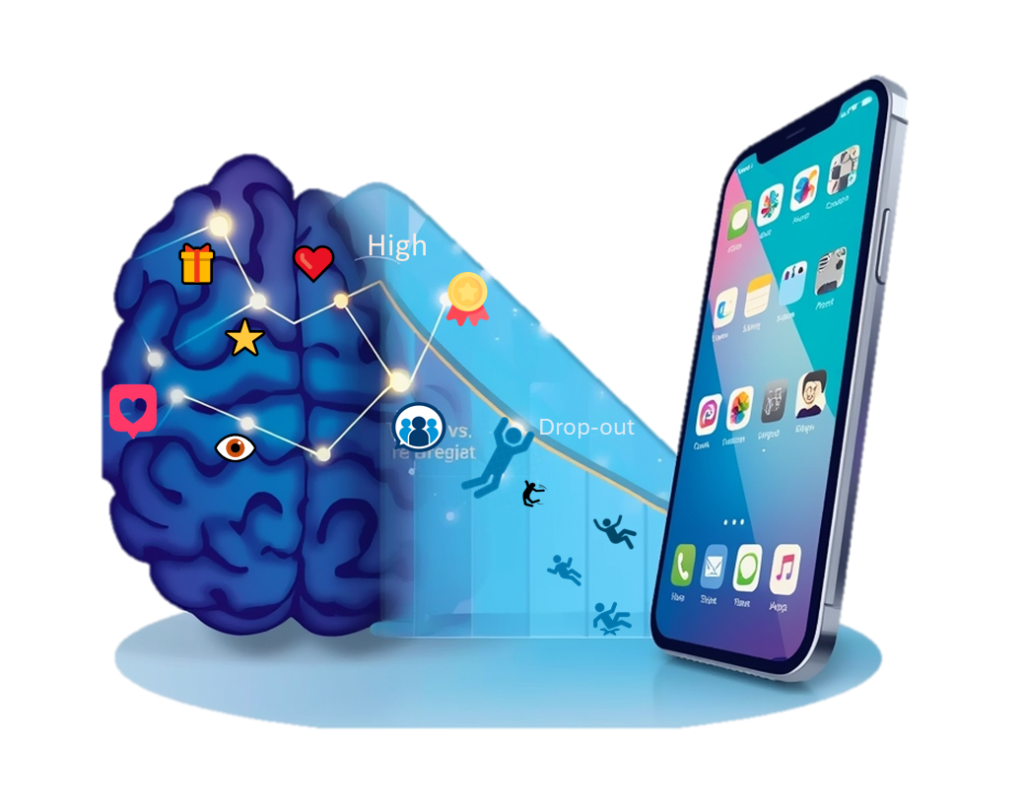
To understand engagement in depth, we need to look beneath the surface and explore how it is shaped by core brain processes.
Engagement with digital apps is the result of how our brain balances three core processes: reward, attention, and emotion.
⚡Reward: The Rapid Decline of Novelty
Dopamine neurons work like a prediction engine. They fire strongly when something unexpected or rewarding happens, and they adjust expectations for the future (Schultz, 2016). This is why streaks, surprise tips, or progress badges can boost curiosity. They simply tap into how the brain learns.
But rewards alone are not enough. Research shows dopamine is most effective when tied to personal meaning, not just novelty (Diederen et al., 2021). Thus, when rewards lack this deeper value, dopamine activity fades, motivation collapses, and people disengage.
👉 Takeaway: Rewards that feel relevant and valuable build engagement. Empty points or badges do not.
👁️ Attention: the brain bottleneck
The prefrontal cortex, our “control center,” can only handle a limited amount of information (Miller & Cohen, 2001). When faced with too many steps, notifications, or choices, we experience overload, which results in decision fatigue (Pignatiello, et al., 2007). This makes even the simplest choice ( like quitting) feel overwhelming.
Evidence comes also from neuroimaging studies, showing that under high load, prefrontal activity drops while disengagement circuits take over (Westbrook & Braver, 2015). This explains why a cluttered onboarding flow or overwhelming choice architecture can kill engagement before it even starts.
👉 Takeaway: Engagement lasts when apps keep things simple.
❤️ Emotion: the glue of memory
If rewards spark curiosity and attention keeps us focused, emotion is what makes experiences stick. It decides what the brain tags as “worth remembering.”
The amygdala helps tag emotional experiences so they are stored more strongly in memory (Paré and Headley, 2023; Phelps, 2006). Recent studies show how amygdala–hippocampus interactions consolidate these memories through synchrony in EEG-brain rhythms (Bradley and Sambuco, 2022; Costa et al., 2022; Qasim et al., 2023).
Both the tone (positive or negative) and the intensity of emotion influence how strongly memories are consolidated (Gao et al., 2024). That is why apps that spark relief, joy, or achievement early on are far more likely activate long-lasting engagement. By contrast, experiences that feel neutral, frustrating, or irrelevant are not prioritized by the brain, making them easy to forget and abandon.
👉 Takeaway: Emotion is the anchor of long-term engagement. Neutral or frustrating experiences are easily forgotten
The Missing Link Between UX Design and the Brain
UX frameworks like the Hierarchy of Rewards (UXCam, 2024) capture what keeps users interested in theory: people value status, access, power, and tangible rewards in different ways. This is a useful lens but it only explains what to offer, not why it works or why it often fails and they rarely change the fact that most apps lose the majority of their users within weeks.
From a cognitive neuroscience perspective, engagement depends on how the brain balances the three forces of reward, attention, and emotion. I observe that this connection is often missing in most UX guidelines, which is why many apps still see retention curves collapse despite following “best practices.”
The table below illustrates this gap. Each row shows a familiar UX strategy, the brain mechanism it relates to, what gets overlooked without neuroscience, and how it can be redesigned to build more sustainable engagement.

The key message to keep in mind is simple: When design is aligned with neuroscience, engagement stops being about tricks, it becomes about creating experiences that truly stick.
Final Thought
In today’s saturated digital landscape, where users are constantly surrounded by competing apps and notifications, the true challenge lies not in merely achieving downloads but in maintaining user engagement over the long term. Apps that are poised for success are those that take into account how the brain processes rewards, attention, and emotion, and that prioritize rigorous research to translate these insights into effective practices. When these elements are harmoniously integrated, digital products can seamlessly weave themselves into users’ daily routines.
If you’re interested in leveraging cognitive neuroscience to gain insights into user behavior and create designs that foster sustainable engagement, I invite you to reach out. Connect with me through my blog or on LinkedIn to start a meaningful conversation.
Let’s build digital experiences that people don’t just try once, but truly connect with over time!
References
Agachi, E., et al. (2023). The Effect of Periodic Email Prompts on Participant Engagement with a Behavior Change mHealth App: Longitudinal Study. JMIR mHealth and uHealth. Open-access full text (78-week dataset and HMM analysis). doi: 10.2196/43033
Baumel, A., Muench, F., Edan, S., & Kane, J. M. (2019). Objective User Engagement With Mental Health Apps: Systematic Search and Panel-Based Usage Analysis. Journal of medical Internet research, 21(9), e14567. https://doi.org/10.2196/14567
Boucher, E.M., Raiker, J.S. Engagement and retention in digital mental health interventions: a narrative review. BMC Digit Health 2, 52 (2024). https://doi.org/10.1186/s44247-024-00105-9
Bradley, M. M., & Sambuco, N. (2022). Emotional Memory and Amygdala Activation. Frontiers in behavioral neuroscience, 16, 896285. https://doi.org/10.3389/fnbeh.2022.896285
Costa, M., Lozano-Soldevilla, D., Gil-Nagel, A. et al. Aversive memory formation in humans involves an amygdala-hippocampus phase code. Nat Commun 13, 6403 (2022). https://doi.org/10.1038/s41467-022-33828-2
Diederen, K. M. J., & Fletcher, P. C. (2021). Dopamine, Prediction Error and Beyond. The Neuroscientist : a review journal bringing neurobiology, neurology and psychiatry, 27(1), 30–46. https://doi.org/10.1177/1073858420907591
Gan DZQ, McGillivray L, Han J, Christensen H and Torok M (2021) Effect of Engagement With Digital Interventions on Mental Health Outcomes: A Systematic Review and Meta-Analysis. Front. Digit. Health 3:764079. doi: 10.3389/fdgth.2021.764079
Gao, C., Ren, J., Sakaki, M., & Jia, X. (2024). Memory enhancement for emotional words is attributed to both valence and arousal. Acta psychologica, 246, 104249. https://doi.org/10.1016/j.actpsy.2024.104249
Inman, C. S., et al. (2018). Direct electrical stimulation of the amygdala enhances declarative memory in humans. Proceedings of the National Academy of Sciences of the United States of America, 115(1), 98–103. https://doi.org/10.1073/pnas.1714058114
Lipschitz, J., et al. (2023). The engagement problem: A review of engagement with digital mental health interventions and recommendations for a path forward. Current treatment options in psychiatry, 10(3), 119–135. https://doi.org/10.1007/s40501-023-00297-3
Miller, E. K., & Cohen, J. D. (2001). An Integrative Theory of Prefrontal Cortex Function. Annual Review of Neuroscience. Classic account of PFC control and capacity limits. https://doi.org/10.1146/annurev.neuro.24.1.167Annual Reviews
Paré, D., & Headley, D. B. (2023). The amygdala mediates the facilitating influence of emotions on memory through multiple interacting mechanisms. Neurobiology of stress, 24, 100529. https://doi.org/10.1016/j.ynstr.2023.100529
Phelps E. A. (2006). Emotion and cognition: insights from studies of the human amygdala. Annual review of psychology, 57, 27–53. https://doi.org/10.1146/annurev.psych.56.091103.070234
Pignatiello, G. A., Martin, R. J., & Hickman, R. L., Jr (2020). Decision fatigue: A conceptual analysis. Journal of health psychology, 25(1), 123–135. https://doi.org/10.1177/1359105318763510
Qasim, S. E., Mohan, U. R., Stein, J. M., & Jacobs, J. (2023). Neuronal activity in the human amygdala and hippocampus enhances emotional memory encoding. Nature human behaviour, 7(5), 754–764. https://doi.org/10.1038/s41562-022-01502-8
Schultz, W. (2016). Dopamine reward prediction error coding. Dialogues in Clinical Neuroscience, 18(1), 23–32. https://doi.org/10.31887/DCNS.2016.18.1/wschultz
Westbrook, A., & Braver, T. S. (2015). Cognitive effort: A neuroeconomic approach. Cognitive, affective & behavioral neuroscience, 15(2), 395–415. https://doi.org/10.3758/s13415-015-0334-y
Cited Industry/benchmark sources
Adjust (2023). Mobile app retention benchmarks (by vertical: D1, D7, D30). Useful cross-category context. Adjust
GameAnalytics. (2023). Mobile gaming benchmarks: Retention rate secrets to reduce user churn. https://www.gameanalytics.com/blog/reducing-user-churn
UXCam (2024). Mobile App Retention Benchmarks by Industries (Day-30 rates by vertical). Health & Fitness ≈ 3.7%, etc. UXCam
Business of Apps (2025). App Retention Rates (aggregate averages D1/D7/D30). Broad market view. Business of Apps

 Cristina Gil López, PhD